

Engineering Consultation
With nearly 40 years of experience, we can meet with your project team on-site at your facility (engineering, quality control, safety, production, and operators) to clearly define the application and the expected productive output of the project.
Installation Services
Positech can supply supervised installation (turnkey or partnership) with local contracted installation personnel or your internal maintenance personnel to assure a safe, efficient installation.
Integration Services
Positech can source and supply entire work cell solutions that may include lift assists, lift tables, conveyors, overhead rails, carts, fixtures, and other ergonomic solutions for a total project solution.
Operator and Maintenance Personnel Training
After a new piece of equipment or process is installed in your facility, it is very important that the operators, production people and maintenance personnel are trained to operate and maintain this installation safely and efficiently.
Planning & Layout Design
Positech can supply 2D and/or 3D layouts and profiles of the existing area and the product flow and production enhancement of the completed project.
Long-Term Service Support
Positech has 24-hour phone support, preventative maintenance services and spare parts support for the life of the equipment.
Case Studies
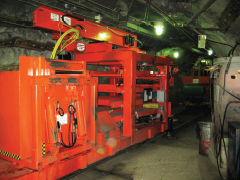
- Industry: Mining
- Challenge: Cylindrical
Limited work space, multiple obstacles, and heavy parts lead to ergonomic problems. Restricted power sources and underground environmental conditions limited the available equipment to perform the tasks. The end-user was looking for a solution to improve operator ergonomics as well as the overall efficiency of this maintenance process.
- Industry: Agriculture, Construction, Military and Defense
- Challenge: Engine Handling
Two machining centers in a 16′ x 16′ work cell. One operator is expected to keep the manufacturing process at peak efficiency while manhandling light, but rather large 20″ diameter parts. The safety and ability of the aging workforce to maintain the required cycle time parameters of the work cell led the end-user to seek an ergonomic solution to this material handling problem.
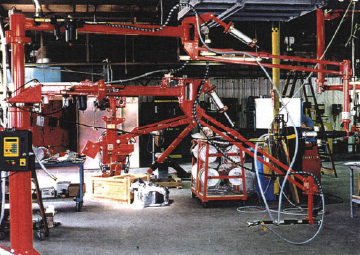
- Industry: Agriculture, Automotive, Construction
- Challenge: Torque and Impact Handling
The different angles and locations of the bolts and a restricted work cell area. A total of four units must be located in the same area with each having a different nut setter doing a different task. The customer would like to reduce the cycle time and eliminate end-effector changes during the assembly process. The ultimate goal is to reduce shock absorbed by the operator.
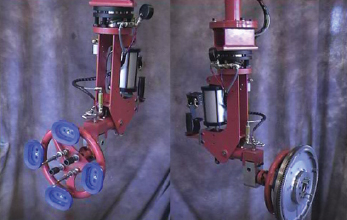
- Industry: Metal Fabrication, Tire
- Challenge: Engine Handling
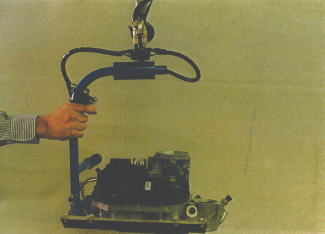
Multiple parts to be handled. The dunnage and bell housing create clearance restrictions above, below, and around the part. This leaves the face of the flywheel as the only exposed surface for gripping. The gripper cannot interfere with power tool access for driving in the attachment bolts. The entire process must be completed within a 54 second cycle time.
- Industry: Agriculture, Automotive, Construction
- Challenge: Engine Handling
Device must handle a variety of parts and part weights. Close work area makes it impossible to use a floor-mounted unit. Cycle time is short.
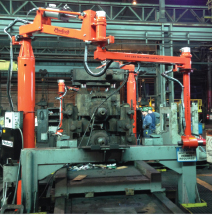
High torque application requiring 100mm nuts being tightened and loosened on a steel fixture. The bolts were both in vertical and horizontal orientation. The application required the operator to use heavy impact wrenches, hand wrenches, and sledgehammers. There was no ability to monitor the actual torque of the nuts and high potential for injury to the employee.
- Industry: Paper
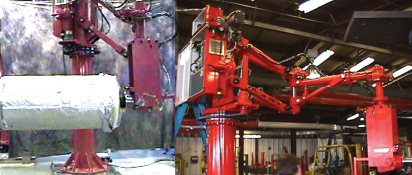
The rolls are very heavy and expensive to manufacture. The largest roll is 63″ in length, 30″ in diameter and weighs 1,450 lbs. While core diameter remains constant at 6″, the length, width, and weigh vary. Vertical travel is a concern in order to be able to retract the material handling device in the vertical orientation. Operator safety is top priority when considering the weight of the rolls to be handled.
- Industry: Metal Production
- Challenge: SEN, Slidegate, Slidegate and Shroud Handling
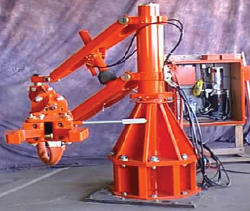
A Foundry environment, extreme temperatures and molten metal were factors in choosing the correct handling solution. Customer had a limited budget to fulfill needs of a new work cell. Previous Positech Manipulator was taken out of service due to new work cell functions.